
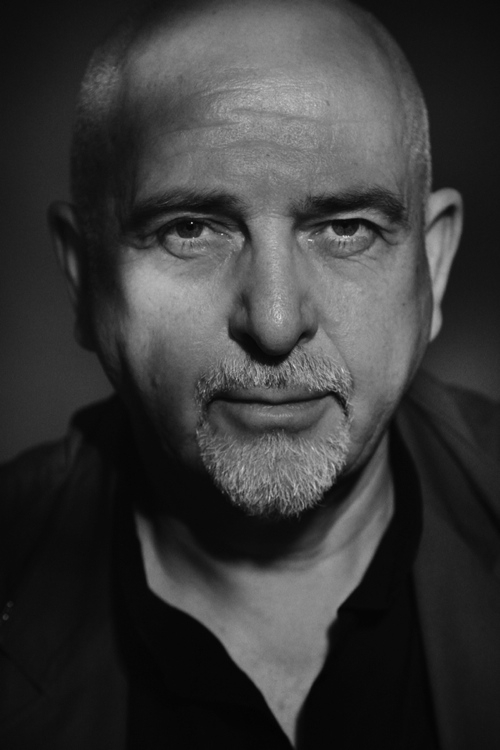
Peter Gabriel - Scratch My Back And I’ll Scratch Yours
“Songwriting brought me to music,” says Peter Gabriel. “It’s just exciting to forge a good song; there’s something magical about it.”
When Peter Gabriel decided in 2010 to turn his attention to the works of his songwriting colleagues and interpret them himself, he never considered for a moment recording an album of simple cover versions. Too many artists have already taken that easy route. Gabriel has always been a musician who avoided conventional rules and refused to walk in the footsteps left by others.
Gabriel envisioned something more fantastic - a song exchange. The first act consisted of selecting a dozen songs from the back catalog of some of the greatest songwriters of the modern pop era and reimagining them from the ground up. His goal was ultimately a tribute to the art of songwriting. The second act was to receive an appropriate response from these songwriters. All those whose pieces he interpreted on “Scratch My Back” were to record versions of their personal favorites from Peter Gabriel's songbook. This would create an exchange, a creative correspondence. Thus, he gave this two-act project the telling title “Scratch My Back And I’ll Scratch Yours.”
Critics may argue that one’s own creativity suffers when relying entirely on the works of others. However, by working with already existing works, Gabriel was able to channel all his energy and creativity and focus on the subtleties and nuances of each individual song. “It’s easier to find holes in a wall than to build a wall from scratch,” he explains.
The long list, which initially included nearly 100 songs, was gradually trimmed down to a neat dozen. The winners were pieces from the pens of Lou Reed, David Bowie, Radiohead, Paul Simon, the Talking Heads, Randy Newman, Elbow, Arcade Fire, and Bon Iver. To get to the essence of each song, Gabriel - along with his pianist Jason Rebello - stripped the songs down to their bones. He then asked composer and arranger John Metcalfe (Durutti Column, Morrissey, Duke Quartet) to provide discreet orchestral frameworks that would never overshadow the source material itself. “I asked John to keep the arrangements simple: plain, but always emotional, so that you could really still hear and feel the actual songs.”
When songs are freed from their traditional rock and pop jargon - particularly by omitting guitars and drums in the instrumentation - they can be recalibrated so that the listener perceives and understands them completely differently. A good example of this is Gabriel's version of Paul Simon's “The Boy In The Bubble.” The original has an irresistible swing, yet Gabriel interprets the piece as if in slow motion, instantly giving it more gravity. “The lyrics are quite dark and disturbing,” Gabriel explains. “And when you strip the song down as we have, you hear the lyrics in a different way.”
When Peter Gabriel listened to the results with the songwriters, they were completely thrilled. “His version of ‘Flume’ blew me away,” said Justin Vernon, mastermind of the band Bon Iver. “He drew attention to certain things in the song that I don’t necessarily highlight with my voice and from my perspective - little lyrical passages or chord changes. This gives the song a different twist.”
Elbow frontman Guy Garvey - another huge Gabriel fan - was equally satisfied with what he heard - a captivating version of the track “Mirrorball.” “He sings the piece with such passion,” he said. “The song has a very special meaning for me because it’s about the woman I love. And to hear one of my heroes sing it so wonderfully over this incredible arrangement really touched me and my partner. That’s an amazing compliment for me!”
“Scratch My Back,” the first part of this song exchange, was originally released in 2010 and is now being reissued in a special edition along with “And I’ll Scratch Yours.” Due to the packed recording and touring schedules of the artists involved in this project, there have naturally been some delays in realizing the endeavor. However, this is offset by Gabriel's joy over the ultimately received feedback. Considering the caliber and careers of the artists whose songs he selected, it is almost unbelievable that, with the exception of two songwriters, everyone was able to reciprocate Peter Gabriel's favor. For Neil Young and Radiohead, who were both unavailable, other high-profile artists Joseph Arthur and Feist feat. Timber Timbre stepped in to contribute their versions of “Shock The Monkey” and “Don’t Give Up,” respectively, to this exciting project.
The “reciprocating” artists chose to approach Gabriel's songs in very different ways. Some took the risk of radically reinterpreting the original material, making it so that the original versions are hardly recognizable in their adaptations. Examples include Lou Reed's gruff remake of “Solsbury Hill” or Brian Eno's shockingly futuristic version of “Mother of Violence.” Others - like Arcade Fire (“Games Without Frontiers”), Elbow (“Mercy Street”), or Regina Spektor (“Blood Of Eden”) - stayed much closer to the originals with their interpretations.
Most of the artists involved in this project knew immediately which song they wanted to tackle. “The decision was easy for me,” says Justin Vernon, who chose “Come Talk To Me.” “There are a lot of Peter's songs that are meaningful to me, but this one is definitely the most important of all. I’m not religious in any way, but if I had a religion, it would be this piece. It’s a searching song, a divine song. I told myself: ‘I want to sing this song. I want to revive it.’”
Of similar significance for Joseph Arthur was the number “Shock The Monkey.” It was the first single he had ever bought. “When I was young, there was a phase when this was the only song I played. It takes me back to my childhood and, in an abstract way - at least in my eyes - it’s about how you evolve through pain.”
Arthur's comment encapsulates what this project was about. “Scratch My Back And I’ll Scratch Yours” celebrates both the creative art of songwriters and the art of interpretation. The two dozen songs of this project constantly remind one of how versatile and well-crafted a song can be - how it can shed its original clothes and completely re-dress itself without losing its identity or soul. The sound may be different, but the message remains clear. The song is the be-all and end-all.
Track by Track of the repertoire from “And I’ll Scratch Yours”:
David Byrne - I Don’t Remember
The obligatory dancefloor number for “And I’ll Scratch Yours” was contributed by David Byrne, who played every single instrument himself. He conveys the confusion and paranoia inherent in the song with the eccentric urgency one expects from him. A prime example of a provocative disco beauty of the 21st century!
Bon Iver - Come Talk To Me
From Bon Iver and its frontman Justin Vernon, one expects enigmatic excellence today. And with his extraordinarily spiritual interpretation of the first song from Gabriel's 1992 album “Us,” he does not disappoint. Lively banjo sounds and a swelling drum unite here with Vernon's supernatural voice to elevate our souls to higher spheres.
Regina Spektor - Blood Of Eden
The sweetness of Regina Spektor's voice and the cheerfulness of her piano initially disguise the vulnerability that resides in this expressive work, originally sung on Gabriel's 1992 album “Us” by Gabriel and Sinead O’Connor. But all of this makes the personal unraveling in the lines “And the darkness still has work to do / The knotted cord’s untying” all the more shocking.
Stephin Merritt - Not One Of Us
Gabriel's 1980s original was pure power pop. Stephin Merritt, founder and leader of the band The Magnetic Fields, chose a radically different approach that, however, dates back to the same era. Merritt conjures for his version, which sounds appropriately robotic, even alien-like, the spirits of electronic pop music from that era: the spirits of John Foxx or the early Human League.
Joseph Arthur - Shock The Monkey
Joseph Arthur didn’t need a second to think about which Peter Gabriel song he would interpret. “Shock The Monkey” was the first single he bought as a child. And since he has listened to this piece countless times and knows every detail of it, it was easy for him to reduce it to its essence. His intense interpretation was recorded live in a single take.
Randy Newman - Big Time
That the Newmanization of one of Peter Gabriel's biggest and brightest hits would blow the imagination was never in doubt. Randy plays all his cards. He stripped the song down to its chassis before reconstructing it with his rolling piano playing and his irony-laden, world-weary voice.
Arcade Fire - Games Without Frontiers
The recording was made just before Win Butler and Régine Chassagne, the leaders of the band from Montreal, could celebrate the birth of their first child. Although their version of Peter Gabriel's first top-ten hit comes closer to the original than any other recordings for “And I’ll Scratch Yours,” they still put their own stamp on the piece. The drums they used, which date back to the time of the American Civil War and are a trademark of Arcade Fire, underscore the timelessness of the message of this song, which deals with the futility of war.
Elbow - Mercy Street
“Mercy Street” is perhaps the most contemplative piece from Gabriel's bestseller “So.” It deals with the tragic life of American poet Ann Sexton, who took her own life in 1974. The piece calls for a compassionate and empathetic narrator. And Guy Garvey's warm and inviting voice provides both in abundance. A near-perfect arrangement and truly wonderful vocal harmonies round this version into one of the absolute highlights of this album.
Brian Eno - Mother Of Violence
“It’s getting hard to breathe / It’s getting so hard to believe.” Brian Eno, the co-writer of “Heroes” (the David Bowie song that Gabriel covered for “Scratch My Back”), reciprocates with a disturbingly haunting version of “Mother Of Violence.” Nothing remains of the melodic folkiness of the original; it has been replaced by claustrophobic electronic sounds and Eno's icy spoken-word recitation.
Feist featuring Timber Timbre - Don’t Give Up
Leslie Feist stepped in last year as Peter Gabriel's duet partner for Kate Bush on “Don’t Give Up.” Here, the Canadian surprisingly takes the lead vocals and has left the “Kate Bush part” to the soul-soaked voice of Taylor Kirk (from the folk band Timber Timbre). Kirk's bandmate Mika Posen can be heard on the violin.
Lou Reed - Solsbury Hill
“It’s crazy,” says Gabriel's longtime sound engineer Richard Chappell. “This is one of the boldest cover versions I’ve ever heard.” It is certainly the most radical song reworking you can find on “And I’ll Scratch Yours.” Lou Reed completely disregards the bucolic charm of the English Southwest that characterized the original and gives the piece a hard, metallic overhaul that relocates the song to the dark corners of New York's Lower East Side.
Paul Simon - Biko
Due to his deep connections to South African music and politics, Paul Simon simply could not choose another song. Gabriel's tribute to the murdered anti-apartheid activist Steve Biko was made for him. And Simon's wonderful interpretation is every bit as haunting as the original.
www.petergabriel.com
Track Listing CD 1 “And I’ll Scratch Yours”:
David Byrne - I Don’t Remember
Bon Iver - Come Talk to Me
Regina Spektor - Blood of Eden
Stephin Merritt - Not One of Us
Joseph Arthur - Shock the Monkey
Randy Newman - Big Time
Arcade Fire - Games Without Frontiers
Elbow - Mercy Street
Brian Eno - Mother of Violence
Feist feat. Timber Timbre - Don’t Give Up
Lou Reed - Solsbury Hill
Paul Simon - Biko
Track Listing CD 2 of the Deluxe Edition (Digi-Pack) with “Scratch My Back”:
Heroes (Original by David Bowie & Brian Eno)
The Boy in the Bubble (Paul Simon)
Mirrorball (Elbow)
Flume (Bon Iver)
Listening Wind (Talking Heads)
The Power of the Heart (Lou Reed)
My Body is a Cage (Arcade Fire)
The Book of Love (The Magnetic Fields)
I Think It’s Going to Rain Today (Randy Newman)
Aprés Moi (Regina Spektor)
Philadelphia (Neil Young)
Street Spirit (Radiohead)


