
“When the moon calls me, I stay awake because I can’t sleep tonight. When the moon calls me, I follow its bright glow all night long.” (Quote: Wenn der Mond) The songs by Bünger are felt from the gut. They tell of the movement of life, the joy of sharing, and the small, fine moments of an encounter. They document fascinating excursions through the night: sensitively captured, without flowery poetry, focused on the friendly light of the morning.
“Life cannot be optimized; it just happens.” Bünger listens; how he speaks, how he thinks, how he defiantly challenges moral principles. He doesn’t want to come across as a new Buddha. He wants to break free from what seems right and important at first glance but ultimately only serves the societal, normalized framework. “My freedom begins in the mind and is lived in the heart.”
People are far too tense; they are greedy, wanting to get too much out of themselves, wanting to shine. But the night does not stand in any glorious splendor: it sucks, pulses, and lives. And with it, all those adventurers, romantics, and losers. “We keep promising ourselves to get our lives under control and yet often fail due to overly strict resolutions, inner demons, and surprising strokes of fate. In the end, it probably suffices to just have a lot of fun and fail a little better each time.”
Bünger does not express himself beautifully or pastorally, but openly, directly, and unflinchingly. He takes a beautiful melody and sings about the wistful and melancholic aspects of a glittering future and the fascinating and warm elements of this rough, hard world. His songs are not bedtime stories but sensitively captured and soberly reflected moments of decisions. “Especially in difficult times, during farewells or in defeats, I have learned the most for my life. Nothing is bad if I know my own path and follow it consistently.” Here in the dark, he does not worry about his scars: he loves the morning with its consequences. Failure included.
This expression, this attitude, this discovery of paradoxes demand inner maturity. And Bünger is grown up enough to articulate himself. For him, the highest good is to have no obligations, to not have to do anything, to not want anything. “There are days when I forget every belief, every meaning. Because I simply enjoy being as I am right now.” (Quote: Am Ende wieder Licht) His happiness begins in the small things. It is his courage and sincerity that win Bünger the sympathy of the audience.
That he often sounds audacious, shaky, and worn may not be surprising: Pauli and his neighborhood, after all. Bünger connects his Hamburg dialect with influences from American genres like blues and folk, and songwriters with German chanson; inspired by the greats like Johnny Cash, Tom Waits, Van Morrison, Udo Lindenberg, Rio Reiser, and Element of Crime. A bit less rough. Elegiac, but not sad. “I have to go outside; I can’t see these walls anymore. They have been gray for years. Pale people look at me, whom you certainly cannot save. They don’t want life.” (Quote: Diese Stadt)
His sound is versatile, rich, and lively: double bass, ukulele, banjo, mandolin, lap steel. Playful and mature at the same time. Confident and free. Tastefully, stylishly, and courageously produced. His creaky guitar, his rough, profound voice, and his fine sensitivity for the special moment demand a new quality of listening. “At 30, I casually churned out every song. Today, the quality of the music lies in improvisation, in the intuitive merging of text and melody, in the connection between me and my audience.” Bünger seeks closeness and intimacy.
His confidence in handling the musical craft has matured: Bünger has been working as a producer in the studio for years, observing, listening to, and studying musicians and people with interest. “One of the most beautiful moments is when I listen to someone who is growing and suddenly gets wings.” Regularly, Bünger invites songwriters, singers, and fellow artists to “Bünger’s Feierabend” for joint music-making.
Music is a process; its success is a concert. The fate of his music, whether it fails or succeeds, is not determined by sales figures but by the intensity and authenticity of the shared experience on stage: Hamburg worldview with signs of use, handmade, rich sound from the gut, and a mature feeling for the musical nuances. That is Bünger.
Sven Bünger has been actively making music since 1981, as a producer, songwriter, guitarist, and singer. He has worked with artists and bands such as Madsen, Johannes Oerding, Pascal Finkenauer, Ulrich Tukur & Die Rhythmus Boys, Angela Winkler, and Mary Roos. Previously, he founded and produced his own band Soulounge and was the band guitarist for the Cultured Pearls for many years.
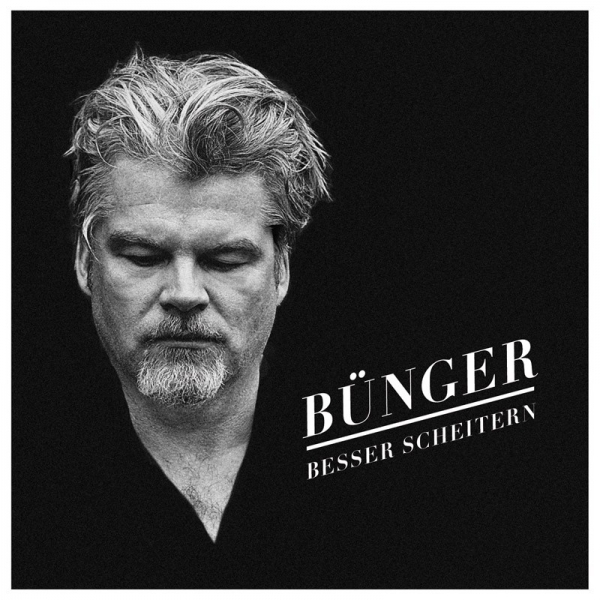
BÜNGER “Besser Scheitern” album has been released by Chef Records Ratekau / Edel kultur.
Videos:
BÜNGER “Wenn der Mond”
BÜNGER “Am Ende wieder Licht”
www.youtube.com/watch?v=Qp_pI_DUuB4
Web:


