12-time Grammy winner Harris and musical partner Crowell release their first joint album featuring exquisite songwriting
"There are legendary country singers - and there is Emmylou Harris: a breathtaking peak of balance and elegance, an artist who surprises with every new release."
(Time Out New York)
"Crowell is a romantic trigger for cheers, with slightly rocking, wildly evolving songs full of sensitivity, consisting equally of roughness and poetic perfection."
(Huffington Post)
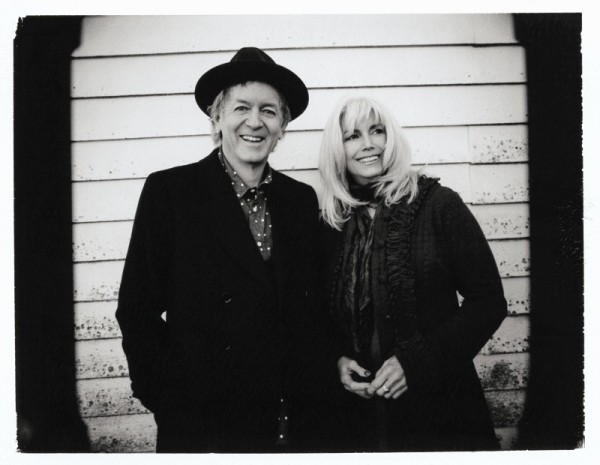
For almost 40 years, they have been partners in music: EMMYLOU HARRIS and RODNEY CROWELL, who was part of the original lineup of HARRIS’ legendary Hot Band alongside James Burton, Glen Hardin, John Ware, and Emory Gordy Jr. With Old Yellow Moon, there is finally an official joint album by the two songwriters, in which they are equally involved. The 12-song duet album Old Yellow Moon features four compositions by CROWELL, who already had an explicit reputation as an independent songwriter when he joined the Hot Band. Good things come to those who wait, and Old Yellow Moon showcases the best qualities of both songwriters, who are considered a true dream couple of country duets musically. Moreover, many Hot Band members joined the sessions for Old Yellow Moon in Nashville, alongside notable guests like violinist Stuart Duncan, guitarist and singer Vince Gill, and Little Feat keyboardist Bill Payne. Old Yellow Moon was produced by Brian Ahern.
Even though the title track of the album, Old Yellow Moon, is the last song on this first full-length collaboration, it served as the starting block for what was to come. "We sat at Ahern's kitchen table to pick a few songs," recalls EMMYLOU HARRIS. "Brian had connected his extraordinary microphones to the computer so we could make a little demo. We sang spontaneously, and somehow I came up with Old Yellow Moon by Hank DeVito and Lynn Langham." Her stand-up performance turned out to be so touching and natural that producer Ahern decided to create an entire track around it. "It's actually a kitchen table recording," laughs HARRIS. "Brian later invited Lynn to play the piano because she felt only she could do justice to our version. We added this and that, and it became the title track of the album." After a brief pause, she explains: "I love how this album was born!"
It was about forty years earlier, in 1974, when HARRIS first heard the voice of RODNEY CROWELL. Back then, she was sitting at a table with Ahern in Toronto, who was to produce HARRIS’ first solo recordings for Warner Bros. after the sudden death of Gram Parsons. They were reviewing song demos, but the session was not going particularly well. HARRIS remembers: "There was nothing that spoke to me, and Brian eventually said to me: 'You know, Emmy, you don't have to listen to a whole song. You'll know which one is right after the first few bars.' At the end of the day without results, Brian said: 'Well, I have one more thing, a songwriter I haven't heard yet. I signed him because someone I trust recommended him.' So we both heard RODNEY for the first time. The first song was Bluebird Wine, and from the first note, I knew: That was the bomb. Brian immediately tried to reach RODNEY, who was on a plane at the time. Eventually, a meeting took place in Washington, DC, where I was living at the time. He played me Till I Gain Control Again, and I knew my instinct had led me right."
A year later, CROWELL recalls, HARRIS was driving through Austin, CROWELL's hometown at the time, and treated him to a plane ticket to Los Angeles. CROWELL became the rhythm guitarist and harmony singer in her then Hot Band. EMMYLOU HARRIS quickly became known as one of the best song interpreters in the realm of folk, country, and rock, and CROWELL soon signed a solo contract and released his solo debut Ain’t Living Long Like This in 1978. He subsequently became a sought-after songwriter, producer, and performer, with songs played by legends like Johnny Cash, The Grateful Dead, Etta James, and Bob Seger - and he continued to be highly regarded by EMMYLOU HARRIS.
Bluebird Wine became the opening track of EMMYLOU HARRIS’ Top-10 country debut Pieces Of The Sky in 1975. Ahern and HARRIS insisted on re-recording the song, but only CROWELL had doubts: "I said: 'Come on guys, I wrote the song when I was 21 or 22, back then, I can do it better today.' So I went home and rewrote the first two verses because the best friend of a songwriter is revision. So I did it and said: 'Okay, this fits a little better with my feelings today.'"
HARRIS adds: "The meat of the song is the same, but he took the author's right to change a few things so that it reflects his life today. Musically, it's the same song, and the soul of the song has remained the same - it's a song full of joy. And whether you're happy at 20 or 60 - it's still joy."
The passage of time - well-spent time, wasted time - is a recurring theme on Old Yellow Moon, especially on Martha Berg's heartbreaking Back When We Were Beautiful and CROWELL's exceptionally wise Here We Are, which HARRIS had already recorded as a duet with George Jones in 1979. "I love this song," she explains. "And even though I sang it with George Jones back then, it seemed perfect for this project. It could be a song about lovers or about a relationship, but for me, it's primarily about friendship."
Like with Here We Are, Old Yellow Moon provided CROWELL with a good opportunity to record some of his songs that he had never recorded himself until then, such as Bull Rider, which his former father-in-law Johnny Cash had already included in his repertoire in 1979. Bull Rider has a nearly cinematic quality and is based on CROWELL's own youth experiences in Texas, which he also described in his 2010 memoir Chinaberry Sidewalks: "When you grow up in Texas, you ride bulls like city kids play basketball. It's just part of the culture, part of the rhythm of life. I've always loved the language of rodeo. It has a poetic tone. I remember wanting to capture this in the song."
For CROWELL and HARRIS, the latter a passionate song collector, Old Yellow Moon is a chance to present all those songs they both wanted to revisit for years, namely country-oriented melodies, especially honky-tonk numbers, that in one way or another represent their shared history. HARRIS notes: "All these friendships, these wonderful connections, come together on the album, many of them without us pursuing a specific thought." The opener Hanging Up My Heart, featuring harmony vocals by Vince Gill, was originally released as the title track of actress and singer Sissy Spacek's first country album. CROWELL himself produced the album in 1983, before Sissy achieved great success with Coal Miner’s Daughter. The song was written by Hot Band member DeVito, who also co-composed Black Caffeine, which was created in collaboration with Donivan Cowart. HARRIS: "We loved Black Caffeine, but it was one of those odd demos that we were somewhat hesitant about. But I think we ended up doing it very well." CROWELL was also a big fan of Kris Kristofferson's 2006 album This Old Road (CROWELL claims he "lived in this album"), and suggested including the remorseful Chase Of Feeling.
The graceful waltz tempo of Allen Reynolds' Dreaming My Dreams, which gained great popularity through Waylon Jennings, is undoubtedly one of the highlights of the album, even though it wasn't initially on the wish list. They stumbled upon it while rehearsing for another song, and HARRIS eventually asked: "Why don't we just do that? Waylon's version is one of the most perfect, but if you turn it into a conversation between two friends, it gives it something entirely new. It places the song in a different context, which you should always do when covering a song that already has its place in music history. I think Rodney and I were able to add a dimension to the song, and Brian's production is simply overwhelming. It also doesn't hurt to have guitarist James Burton play on it."
EMMYLOU HARRIS then chose a song by E Street Band member Patti Scialfa: Spanish Dancer from her widely underrated Rumble Doll collection from 1993. "It tells a very special story of a female experience; it's so beautiful. I had it on my list of songs I wanted to interpret for years, and I was almost reluctant to suggest it. I thought, maybe I'm already beyond that, maybe I can't really interpret it in this phase of life as it deserves, but some things are so universal that it wouldn't matter. You always long for certain things, no matter what age you are."
Going back into the studio with EMMYLOU HARRIS "feels just like it always has," says CROWELL. "We were young and naive, and that was very delightful, and the whole world was still ahead of us. Then you move on. Emmy and I have stayed close all these years, but she went her way and I went another, and sometimes we met by chance. But when we came back together now, it was as if no time had passed at all. In that respect, we are like blood brothers."
"From the first moment we sat down with two guitars and our lead voices on the floor in the studio, singing Don Gibson songs and just messing around, we told each other that one day we would record a joint album," confirms HARRIS. "It always seemed inevitable. But nothing is inevitable if you don't take the time at some point to say: 'Okay, now we're doing it.' It was always something that would happen at some point. And I'm glad it has happened now, at this point in our lives and careers."
Old Yellow Moon is full of beautiful memories and deep connections, but it is also a document of where the ever-evolving EMMYLOU HARRIS and RODNEY CROWELL find themselves at this moment - as musicians and as friends. Or, as CROWELL says: "The truth lies in the fact that neither Emmy, as far as I can tell, nor I will ever finish the work one day by patting ourselves on the back. Whatever we did before has always just been a beginning. It's like saying: okay, let's make an album. Isn't it great that we can do that? And then the songs come into play. If they are good, then you strive to deliver a performance that does justice to the song. And if you've done that often enough, then you have an album together. Everything else would be artificial. I think that's the commitment to the art form of the song, so we can then hand it over to the audience, which then makes it their own."
Old Yellow Moon is EMMYLOU HARRIS' direct follow-up to her album Hard Bargain, which made it into the Top 20 of the Billboard 200 last year. The Associated Press called it "charming" and confirmed that HARRIS’ "silver soprano is in good form," while USA Today wrote it was "exquisite... her distinctive soprano, both grainy and ethereal, still wraps around the lyrics like the sensitive warmth of an angel."
For over 40 years, EMMYLOU HARRIS has been a fixture in the American folk scene and is considered one of the most enduring artists of her genre with over 15 million albums sold. The grande dame of US songwriting can boast 12 Grammys, celebrating her 66th birthday on April 2. As an interpreter and songwriter, EMMYLOU HARRIS has released over 25 albums, and her collaborations with Gram Parsons, Neil Young, Roy Orbison, Linda Ronstadt, and Dolly Parton enjoy the status of historic achievements. Her work with Connor Oberst (Bright Eyes), Mark Knopfler, and Daniel Lanois has also been groundbreaking. In 2008, she was inducted into the Country Music Hall Of Fame.
RODNEY CROWELL is also a multiple Grammy winner. Some of his songs have found their way into the repertoire of Johnny Cash, Norah Jones, Etta James, Grateful Dead, and others. His breakthrough album Diamond and Dirt, released in 1988, included five US No. 1 singles and earned him a Grammy for the song After All This Time. His critically acclaimed albums The Houston Kid, Fate’s Right Hand, The Outsider, and Sex and Gasoline were followed in 2010 by the release of his memoir titled Chinaberry Sidewalks. This year, KIN: Songs By Mary Karr and Rodney Crowell was released. The album debuted at No. 1 on the Americana and Country Rock album charts and stayed at No. 1 on the Americana Charts for three weeks. Honors he has received include the ASCAP Lifetime Achievement Award and membership in the Songwriters Hall Of Fame.
This article was automatically translated by AI.

More News

24.10.2026
In Extremo release their acoustic album "Tranquilo II" today along with the video

24.10.2026
New Music from David Kushner

24.10.2026
The End of Youth (Punk; Freiburg) - new EP "Tomorrow Will Be Worse" - Release Date: 22.10.

22.10.2026
50 Years of Punk: Düsseldorf Opens the "Punk Museum" at the Theater Museum