Q: You are playing today at the Tommy-Haus, a former squatted house. Do you have a special connection to the house or the squatter scene?
L: When we played in Berlin for the first time, that was in 1981 at S.O. 36, I assume that many in the audience came from the squatter scene.
We also played a lot in squatted houses back then, for example, in Hafenstraße in Hamburg. So there is a connection, and they were right in what they did.
However, we have never played at Tommy-Haus before. This is our first time here.
Q: What is your general stance on the squatter scene? A lot of things are no longer possible today that were possible back then.
L: I have to say that I am not really in touch with it anymore to judge. Down here in the south, it doesn’t really exist anymore. In Stuttgart itself, there are actually no squatted houses anymore.
In our youth, we once squatted a former youth center. That lasted a few weeks, but to be honest, I’m not involved in that anymore. I also don’t know if these actions are outdated today. At least in Berlin, there is somewhat affordable housing available.
I don’t presume to assess whether this is still as urgent today as it was in the 70s and 80s.
Q: In the past, it may have been about affordable housing, but today it seems to me more about creating spaces for subculture. Places where people can meet. Do you see enough free spaces?
L: There can never be enough free space! Free space must be available everywhere, in music, in everyday life, just everywhere. I believe that the free space one needs has certainly diminished today. I wouldn’t want to be 15 or 16 today. I wouldn’t want to have as little free space as a 15 or 16-year-old today. But that’s not just due to the offerings available, but also to the mindset that many simply no longer have. Many no longer see “freedom” as a fundamental idea. For them, freedom means being able to buy an iPad or a car to get from A to B. But that’s not the freedom that was fought for back then, and it is diminishing. Freedom itself is increasingly being restricted.
Q: You have now released the film “Jongr,” which is also somewhat autobiographical. Why did you make this film?
L: We just wanted to do something completely different than just release a new CD. That’s familiar, we can do that, and it wouldn’t have been a problem to do. But we said to ourselves, “We need to try something completely different.” We originally thought of a punk revue. We wanted to create a punk revue, a revue with old punk songs from bands that inspired us in our youth. We would have played that, and that wouldn’t have been a problem. Then it was about building a storyline around these songs, which also wouldn’t have been a problem. We already had a kind of script to do that, but then it came down to the actual implementation. We would have had to go out with the intention of performing it live. We would have needed 4-5 actors, movable sets that would also have to be built, and then we would have been talking about two trucks to drive around Germany and play in front of 50 paying spectators. That simply wouldn’t have worked financially.
Actually, the film wouldn’t have worked financially either. We worked our asses off to somehow finance the film. By chance, Manne (bassist of Normahl) met a former classmate of his who now makes films, and then we said, “Let’s make a film about it.” The film was conceptually designed to take place in the time from the death of Elvis Presley to the death of Sid Vicious, so in a narrow timeframe of about 1 ½ years, essentially in our youth from 1978 to 1979.
Q: Was it primarily about showing what it was like to be a rebel in that time in the countryside, or did that just happen?
L: Of course, it was about conveying our own youth in the film. There are already films like “Dorfpunks,” but what we wanted to present is how freedom looked the way we wanted it to look and to do what we wanted to do, was indeed. This freedom had to be fought for back then. That’s what the film should convey, this struggle.
Today, it’s the exact opposite. Today, no one cares how you walk around. Today, you just have to function.
It was, of course, a completely different time. Our parents were certainly very different from us, who today might be parents ourselves.
Q: Do you think that people, the population, have generally become more open?
L: Of course! It’s like this: the older population is now our age, and of course, they are different from our parents. But there are just as many who didn’t rebel back then and sat in a pub at 18 and said, “I live like my parents lived” and stick to it.
I am often asked whether rebelling and our (band) life as we lived it has brought us anything. I always answer that it has brought me exactly that I don’t sit in some pub and talk the same crap my father talked back then.
Q: In your song “Deutsche Waffen,” you also sing about Germany's arms exports. In southern Germany, there are several large arms manufacturers that export a lot. How does the local population deal with that? How do you deal with it?
L: It is known that Daimler is not an unblemished sheet or Heckler & Koch, who are almost around the corner from us. Most people don’t really understand what it’s all about. It only becomes interesting when you get closer to the whole story, like now in Libya, where the guys are shooting each other with German weapons. Then, very specifically, maybe some who work in such companies think about it. But I believe that the majority of people don’t think much about it.
In my view, the real peace activists, the true convinced pacifists in Germany are becoming fewer. You can also see that most people completely tolerate the Bundeswehr's foreign deployments. Political awareness has weakened.
Q: What is your stance on the Bundeswehr's foreign deployments?
L: For me, that’s unnecessary. I have a very clear opinion, and that is that there is no need for a German army anywhere in the world.
Q: You have written very striking songs against Germany on your current album with the song “Friss oder stirb,” just as you have in the past.
L: Those are not songs against Germany.
Q: One can understand it that way.
L: You have to distinguish between a country that represents a certain government or a certain system and a country that is still my home, whose language I speak and whose nature I certainly love. I also appreciate certain ways of life in Germany and what one has in this country. It’s not that I reject Germany as a country. That’s not true.
It’s about the fact that the system that has been the same here for 200 years or more is, in my view, not okay. I am not a Germany-hater!
Q: I think, however, that with statements you have made, people can understand it that way, and then think that those who don’t like it here should move away.
L: Move where? There is no more GDR.
Q: When I see your songs that hit the nail on the head, I think that nothing has changed.
L: Sure, but those are all songs against the system. Germany is a country like any other in the world. I have to live with this country. I don’t feel like moving to France, for example, and dealing with all that crap again. I believe that the system needs to change.
Q: You mentioned the GDR...
L: ...that was meant as a joke because back then, when we sat in a pub, we always had to hear, “If you don’t like it here, then go over there.”
Q: In my eyes, the population in Baden-Württemberg had little contact with the GDR and knows it more from legends and embellished stories. How do you see that?
L: I see it the same way, but who is supposed to know it anymore?
We as a band played in Hungary in the 80s. I remember a concert in a large hall with about 1,000 people. We thought we would just play there, but it would go over the heads of the people. We, as a German punk band, don’t interest anyone. When we played, everyone sang along! We only realized after the concert, when we spoke with a few concert-goers, that the people who were there all came from the GDR. They traveled to Hungary because they were allowed to go there to see NORMAHL.
We were also one of the first bands to play in the existing GDR. So with borders and everything.
Q: You must have played in a church then?
L: No, it was in a salt mine.
We were on tour at the time. We had just been in Aachen and had two days off. Then the news came that the revolution had just started in the East, and then a booking agency asked if we wanted to go over. We did that and played a few concerts in the still-existing GDR. We were able to get an impression of the GDR before the collapse.
For the younger generation or the people from the West who have never been there, it’s such a past notion that is as real or unreal as the generation that grew up after the Third Reich and didn’t experience the war. I even believe that many young people today don’t know what the GDR was.
For us, it was always very interesting when we drove to Berlin during the border times. You drove on the transit route through the territory of the GDR without getting to know the country much. The border controls and everything, that was always a theater and very exciting. The only thing they never checked was whether you were drunk.
What you got from the GDR was only what you saw through the propaganda television we had, and it was the same over there.
Q: You were also often in the crosshairs of the state security. Has that calmed down now, or are you still in their sights?
L: The state security actions have become more subtle today.
I had a random house search about 4 or 5 years ago for absolutely flimsy reasons. My documents and my computer were then gone for months. I couldn’t access them anymore. When I inquired about where they were, I was told they were with the public prosecutor's office I in Stuttgart. That’s the public prosecutor’s office known for dealing with state security matters. They also dealt with the R.A.F.
It’s no longer the case that records are confiscated. We also received complaints for “public calls to commit crimes.” It’s much more subtle and meaner today than it used to be. There are methods that they probably adopted from the former GDR. They try to hit people in their everyday lives. They try to get your money with fines and keep putting obstacles in your way that you then have to clear away.
Q: How can one deal with that? What would you advise people who have such problems?
L: You have to stand your ground!
What I always find a bit ridiculous is the NPD. Half of the party consists of people from the constitutional protection, which also means that the constitutional protection in a way finances this party. You just have to stand your ground against such people. You also have to say, in general, how ridiculous the “constitutional protection” is. What does this organization want? Their constitution, which they want to protect, is being broken day by day by themselves or by some people in the Bundestag.
In this respect, you also have to convey that outside and treat them accordingly.
Q: Speaking of constitutional protection, the church is not far behind, which you also criticize regularly. You must have made many enemies in Baden-Württemberg, right?
L: Time has certainly proven us right. If you look at how the Catholic Church treats its abuse victims today, we were right in what we said, that they are a deceitful bunch and far from their truthfulness. I’m not one to say that the church itself is total crap. If someone really believes in it and wants to pursue it, it may also be justified for someone to want to become a pastor, but the deceitfulness we talked about has certainly occurred. We knew what we were talking about. When all of this came out, you could actually say, “Okay, Normahl was right.”
Q: Do you then laugh to yourselves and feel happy?
L: For the abuse victims, it certainly wasn’t nice that it actually happened, and the labor camp-like conditions that prevailed there for a long time were certainly not nice. These are things that happened, perhaps 20 years ago, that were not far from a totalitarian state.
My personal opinion is to completely separate the church from the state. This is the only right way for Germany. Then maybe some people would consider rejoining if there is a complete processing and not just money is paid to keep quiet.
Q: On your last albums, you have also included sad, melancholic, and dreamy songs like “Der letzte Cowboy,” “Schneestürme,”
or “Sonne im Dezember.” How did it come about that you made these songs?
L: We have always made such songs in some way. Maybe not at the very beginning, as we were purely punk then, but songs like “Geh wie ein Tiger” or “Blumen im Müll” are similar. Such songs are allowed in punk. Mike Ness from Social Distortion recently said, “Punk is the music of freedom.” We were always criticized for the song “Hans im Glück.” The song was considered a real rock number. And today, people like it when we play that song live; it always goes off well. “Hans im Glück” is a punk song, maybe not in rhythm but in message and lyrics.
Q: Have you thought about the fact that such songs might come across as embarrassing?
L: No, although we do question ourselves there. We don’t want to tell stories at our age that should appeal to 15 or 16-year-olds. That wouldn’t make sense. When you write lyrics, they should also be taken seriously. A certain seriousness is also part of punk.
When writing new songs, it is indeed difficult because we do think about what 15 or 16-year-olds think who come to our concerts.
If we were to tell total nonsense, like some German punk bands do that are that age and where it fits, that’s something else.
We wrote songs in 1980 that we still play today, but we play them with the mindset that you can laugh about them. They are still great songs, but do you have to see that in your 50s with all the energy? We also like to rise above things and tell people that punk is more than just running around with a mohawk. Punk is a way of life.
Q: You would like it if others could benefit from your life experience?
L: Sure. There are incredibly many people our age who still try to live their lives somewhat self-determined. That’s definitely possible! You don’t have to be punk at 15 or 16 and think about family planning at 20. You don’t have to do that. You can definitely combine the two. You don’t have to become a conformist just because you turned 20.
Q: Is it sometimes difficult for you to play in front of a young audience?
L: I have never been afraid of that because punk has always been a youth movement. Punk has always had a new generation. The new generation also lives off new bands, young bands that excite you. I can’t imagine that someone becomes punk because they listen to a Normahl record.
We grew up with the punk scene. We still belong to this scene. In my opinion, bands like Normahl or Die Toten Hosen cannot push the movement forward. The movement can only be pushed forward by bands from the generation in which punk arises. That’s where I’d rather start because writing the thousandth song about cops is nothing new.
There are completely different problems today than those we had in 1980.
Q: I feel the same way. I think that the songs from back then were more about free expression, and today it’s more about survival itself.
L: But that can also be packaged in a lyrical text. You can also tell the punk movement that they should think about art.
The people are much more intelligent than you think. Of course, there are also idiots who don’t understand songs like “Deutsche Waffen,” but I believe that the majority understands the irony behind it. We still play the song today because it is still relevant. Such numbers are timeless.
We don’t play songs like “Rainer Anton Fritz” anymore; nobody needs that anymore.
Q: What is your stance on the RAF? Do you think the struggle of the RAF achieved anything?
L: It was a consequence. It had to happen, although the RAF is now also accused of having set the surveillance state in motion and created it. The surveillance state was already there before the RAF. It was seamlessly taken over by the Nazis. In this respect, it certainly moved something. Discussions arose that would never have reached the Swabian province without the RAF.
Through the RAF, discussions about topics like “What are we living for,” “Who determines us?,” “For whom do we work every day?,” “Is everything really okay as it is here?” were initiated. I believe that these discussions moved a lot in people’s minds. Such discussions would never have emerged from elite circles without the RAF.
At a regulars' table in a small Swabian town, no one would have had such thoughts if there hadn’t been something like the RAF.
However, you shouldn’t sell us Swabians short; we now have a Green-Red government! And that after 50 years of CDU!
You can see that something has changed. A whole new generation has stepped forward, even if Kretzschmar (current Minister President of the Greens) doesn’t come from that generation, but the people voted that way. People react very differently today when you mention nuclear power than they did fifteen or twenty years ago. That also has to do with the experiences they have had. In the past, people wondered why more people than normal died of leukemia in the areas around the nuclear power plants in the southwest. Back then, the attitude was somehow that it had to be that way. The current movement has created a change in thinking.
It’s also about efficiency now. For example, you don’t have to heat with electricity. There are other things you can use to heat.
Overall, it has brought a lot, although it sucks that it has now been institutionalized again.
You also have to see clearly that most of the RAF came from the Swabian province. So it’s not that the Swabians are a total bunch of idiots or were. The RAF moved something, and in that respect, it also achieved something.
Q: It seems to me that on your older records, you also had a lot of sympathy for the RAF.
L: We did, of course! Punk is also provocation. Punk only works that way. Whether that would have been lived out by everyone in the last instance, and whether it would have been right if everyone had taken a weapon in hand and shot around, is a completely different story. Musically, we certainly sympathized with the RAF. We did that quite deliberately to simply draw out all the regulars. But it wasn’t just the RAF; there were also songs like “Fahneneid.” For that song, they wanted to kick us out in 1980 at the city festival in Winnenden from the reservists' association...
...there were people who said, “Give me a gun. I’ll shoot those assholes.” They were provoked solely by this text. Even in this area, something is happening.
No one would come up with the idea of saying something like that today.
Q: What are the plans for the future of NORMAHL?
L: This year we are playing a few unplugged concerts. We came to these gigs like the virgin to the child. In Berlin, we played the first unplugged concert at the invitation of the Hardrock Café. They organized a press conference for our film “Jongr” when we had it finished. At the press conference, the journalists present said, “Since you’re already here, why don’t you play something?” There was no sound system, but we said, “Okay, then we’ll just play something.” They organized the instruments, and then we just played a few songs of ours. That made quite an impression because many only knew Normahl songs that hit hard, and then it suddenly came out that what we do can also be more.
Then we were asked if we could play unplugged concerts in cinemas for the screening of the film “Jongr.” That’s how it came about.
Meanwhile, there are even people asking us when the record with the unplugged songs will be released.
If anyone is interested in screening the film “Jongr,” they can feel free to contact me at any time. In Berlin, for example, it hasn’t been shown yet. You can nicely combine it with a gig on the way there or back. That has always been a great evening so far. It fits very well together. First the film and then the unplugged concert; that fits well, but it’s of course something completely different from a punk concert. It’s a different atmosphere, but it’s a really great atmosphere. We have done this even in large clubs like LKA in Stuttgart or Backstage in Munich. So far, there has always been a very good audience. The audience reacts very differently than at a punk concert. That is still fully in our focus because we want to promote the film, of course.
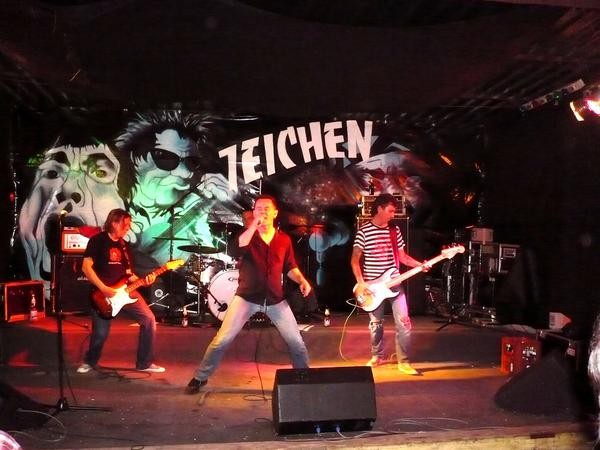
Yes, and then the memory of my dictaphone was exhausted. Lars and I still talked for another good half hour in a pleasant atmosphere in the backstage of the Tommy-Haus.
Of course, NORMAHL's concert that evening was great.
The report of the concert can also be found at ramtatta.de under: