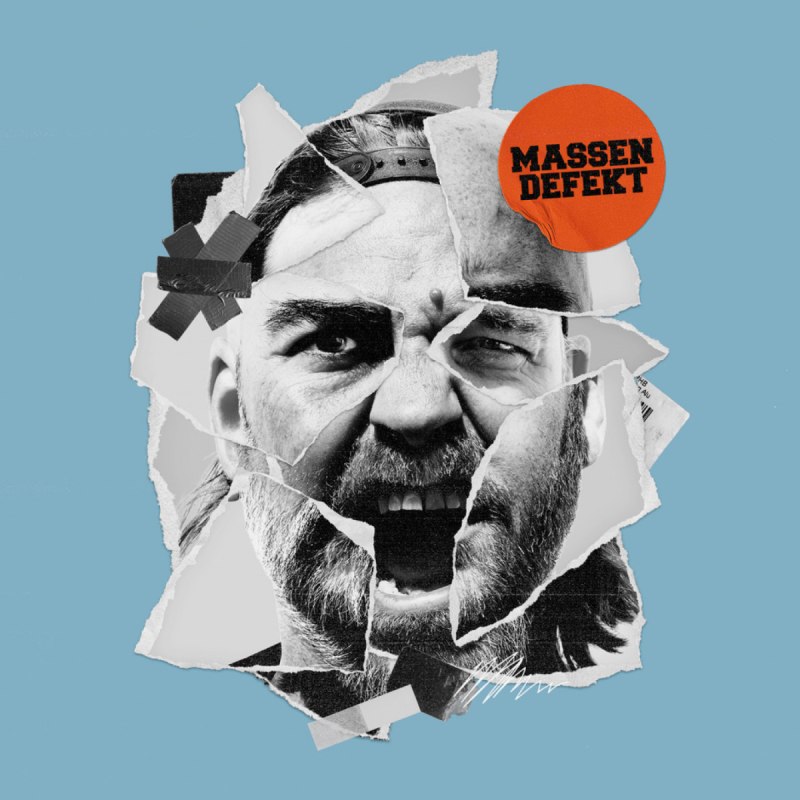
Q: On May 2, 2025, your second book "Taxitanic" was published,
featuring stories from your life as a taxi driver. You have since stopped driving taxis. Were the experiences too disturbing in the long run?
A: "Long-term disturbing" was nothing. A lot of special people get in and out, with whom I have to communicate more or less, but no one ever held a gun to my head or choked me from behind or anything like that. Some experiences have lingered with me longer than others, and I have written down quite a bit to process them.
Q: Do you see the taxi as a kind of safe space for passengers, where they
speak more openly than outside?
A: Some actually use it for exactly that. Especially lonely old
people sometimes really start chatting and share very personal and emotional stories. They often have no one else. They go from the doctor to home and from home to the supermarket. That's it. A low-stimulation and reduced life without much participation. A taxi ride can become a special event to express oneself.
Q: You drove taxis for a long time; what changes have you experienced in the
social and societal context?
A: What is happening outside as well. People are much more willing to
speak out again. I consider it an achievement to think before we say something. However, many are eager to just blurt things out and want to be allowed to say everything. Even the stupid stuff, the unempathetic, the racist...everything.
That gets really annoying, even in the taxi.
Q: Would you recommend someone to become a taxi driver today?
Is it still worth it?
A: Definitely not, I lost my job because the business could no longer
operate economically. The actual revenues have not been able to generate the minimum wage in recent years.
The industry is dying right now.
Q: You have held several readings from your book "Taxitanic" in recent weeks. How were the reactions?
A: The readings were almost universally great. The reactions were very positive. The
book works well, I noticed. I connect each story with societal discourses. How and what do we communicate in public space?! That is my topic. Developing strategies in uncomfortable situations, getting fit for difficult conversation partners.
Q: You move a lot in Berlin-Neukölln, Kreuzberg, and the surrounding areas. How
has life there changed for you and overall in the last 20 years?
A: It feels like everything has become fuller and twice as expensive. The stress level is
rising, as is visible poverty. You can see the physical and mental instability of many people on every street corner. Most are fighting for survival in one way or another.
Q: Your life has mostly taken place in the left and left-radical spectrum; how do you see this "scene" currently positioned,
especially regarding the danger from the right?
A: There is a big difference compared to back then. But it helps no one to
compare that. On the street, we were simply more resilient. That makes a big difference for the self-confidence of social movements. If you are constantly being pushed around and getting beaten up, your motivation eventually fades. Or you simply become afraid, which paralyzes you. And those in power take protest and resistance even less seriously than in the past. They also no longer take large NGOs like Amnesty International, Medico, or Greenpeace seriously. They disregard international law with great calm. They disregard human rights. The danger from the right is enormous, and the word antifascism can hardly be found in any party program. Bad times for emancipated ideas.
Q: In the left sphere, there was a strong anti-militaristic or pacifist movement for a long time. In my opinion, this has almost dissolved with the start of the Ukraine war. How do you see that?
A: I never perceived this movement as particularly strong. It always had the problem of having few arguments against "realpolitical necessities." I think it would be right to start again with radical demands aiming for complete demilitarization. RHEINMETALL DISARM is also a start!
Q: How is it for you to raise your voice on stage, to address points that are important to you, also in terms of being listened to and being able to provide food for thought?
A: It feels very "normal" to me because I have been doing it for over 40 years. Positioning oneself in relation to the system and looking together at how we can shake up the conditions has always been the driving force of my work. But these are collective processes. A performance can be a trigger, just as you describe it. Texts and statements must continue to resonate in discussions afterwards. Thoughts need to get moving, and from that, action can arise.
Q: You have stood on stage for many years, both solo and with bands. What are your musical plans?
Is anything coming up? Do you have ideas for new projects?
A: There is nothing concrete coming up. The book is freshly out, and I will still do a few readings with it. I look forward to inquiries.
Option Weg, my current band, will definitely play in Hamburg, Göttingen, and Berlin in October and November.
Solo, I also occasionally have something come up. I no longer stress myself. I do what I can, what I feel like, and what I see as meaningful.
At almost 63, I am not planning any new projects now. I might like to play a role in a feature film again. Maybe something like Dave Johns in I, DANIEL BLAKE by Ken Loach, who surprisingly got that lead role. He is actually a comedian, and Ken Loach apparently wanted him for the film. I wish for something like that. And it’s not just any film, but really the best social study and politically great like almost everything by Ken Loach. Otherwise, I don't look too far ahead anymore. Let's see what is still possible in old age...