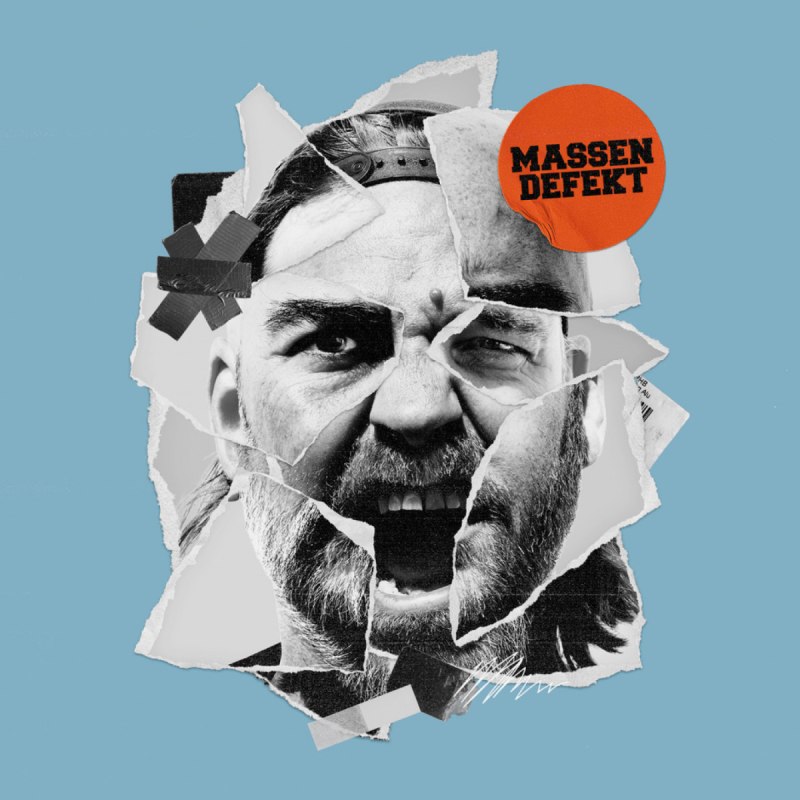
Q: 20 years of TALCO. How does that feel?
What have been the highlights for you since the band's inception?
A: There have been many highlights, perhaps every moment was important.
We have always seen the journey of TALCO as a ladder, where
every decision, every tour, every album, every promotion has brought an additional
step. For an independent band, it is a great
satisfaction to see that this ladder still has many steps to
overcome.
There are certainly very important moments in the history of TALCO.
These moments include our first album “Tutti Assolti”, produced by
Kob Records, then our performance at the “Punk Italia” festival in Berlin in
SO36 in 2005. Then the release of our third album
“Mazel Tov” in 2008.
Not to forget, the switch to Destiny Records and especially,
starting with the “Silent Town” tour, the management of David HFMN.
Those were perhaps the moments when we took more than one step after
the other.
Q: I still remember your concert at the restaurant “I Due Forni” in
Berlin. What special relationship do you have with Berlin?
A: Berlin was the first city that accepted us and allowed us to be
who we are. There we met Mauro (at that time the chef and owner
of “I Due Forni”, now Mauro runs the smaller pizzeria “Il
Giradischi” at Oderberger Straße 22 in Berlin; author's note) and Franco, our guardian angels, and we have always received so much.
That’s why we have always felt more like a band from Berlin or
Barcelona than an Italian band; our friends and our crew are there.
Of course, we have kept some Italian vices, like being late and eating like animals, but when it comes to professionalism, we have always leaned towards the German reality, which we greatly appreciate and to which we owe a certain maturity in dealing with this
passion, which is definitely a job.
Q: Silvio Berlusconi has now passed away. What do you think, how long will
the “Berlusconi system” continue to live on?
A: In 2012, we decided to release one of our perhaps most popular albums,
the album “Gran Gala”. It is a concept album about
Berlusconism, which came out at the end of the “Berlusconi system” (Berlusconi
was a member of the Italian Chamber of Deputies until 2013;
author's note). Berlusconism has a
perverse, corrupt, mafia-like, and sexist mentality that has irreparably destroyed our
society.
We wanted to release “Gran Gala” at that time and draw attention to this system in a catchy and superficial way.
At that time, many claimed that with Berlusconi we had also gotten rid of
Berlusconism, but the facts told a different story,
because the mentality had taken root everywhere, on the right and also on the left.
It was a mentality that destroyed everything, and right now we are seeing its
most tragic consequences with the populist governments that are succeeding each other in Italy, the infiltration by the mafia, the individualistic and selfish exhibitionism of many people, the dark friendship of some right-wing parties with the mafia, and the infiltration by Putinist Russia.
Berlusconi has left a legacy that we will not be able to shake off so quickly.
Q: How would you describe the situation of organized crime in Italy?
Are there differences between Northern and Southern Italy?
A: I believe that the fairy tale that the Lega (until 2017 “Lega Nord”,
then “Lega per Salvini Premier” (short “Lega”), author's note) tells about the mafia in the south, thanks to Forza Italia, Fratelli d'Italia
and the Lega itself (which has brought the “Ndrangheta” to the north), makes no sense at all.
Italy under Berlusconi and after Berlusconi is a bureaucratic
melting pot where the mafia has infiltrated every corner, every party, every local
administration, and everything else.
We always think of the mafia in terms of massacres and bombings, which
are the most tragic aspects and are seen by everyone, but the silent
and dangerous mentality that arises from these infiltrations
ruins the morals and culture of a country from the ground up.
Q: What is the current situation of refugees in Italy?
A: The situation is very serious because there is a populist government that is
not only intolerant and far-right but also very incompetent.
The government plays with people's fears.
The government instills fear in people.
The government does not implement a reception plan for refugees. Sometimes
people are even left behind in the sea. From our perspective, the crimes being committed here, whether indirectly or directly, are
and remain crimes.
One of the last songs we wrote, “Muro di Plastica”, is about a person who falls asleep while playing a video game about the death of refugees at sea. When this person wakes up, they are in the video game. They are one of the refugees.
The boat they are in is about to sink. They see their sleeping self as a refugee. They call for help, but their self does not hear it.
The moral level of humanity is exactly that for me.
Q: You come from Marghera, a district of Venice on the mainland.
Venice has now introduced a tax for day tourists. Will this improve the situation in Venice?
A: Not at all!
Venice is left to a useless, ignorant, and harmful
mayor.
In Italy, we say that Luigi Brugnaro, the mayor of Venice, is a
Berlusconi who has not succeeded.
A Catalan friend of mine was in Venice just yesterday and told
me that the city was full of tourists.
That is the result of a city administration led by an entrepreneur
who has been doing his own thing for years. The city is left to decay, and the blame is placed on the previous mayors and
their administrations. Luigi Brugnaro pretends that everything is in
perfect order.
Luigi Brugnaro has been mayor for nine years now.
Someone must have voted for him too.
However, it is pointless to blame him when we have zero civic sense
and zero political awareness.
Q: What is the current state of the punk scene in Italy?
Are there any bands you can recommend?
A: In our opinion, the Italian punk scene has unfortunately died in the early
2000s.
Perhaps that was the impetus for us to focus on the foreign scene since the founding of
TALCO.
The Italian scene was unfortunately very often selfish, closed off, and
opportunistic. There has been and still is a great sense of envy among the people.
When someone has managed to establish something with great effort, to create a free space, they are looked at negatively. This often happens from
people who are not used to hard and honest work. Others are often blamed instead of reflecting on their own lives
and circumstances.
There are young bands out there who are bending over backwards to pick up the pieces of a
dead scene, telling each other how good it used to be and how much the new generation annoys them. Many people invent stories from the past just to make them look better than they actually were.
For us, bands like Punkreas, Persiana Jones, and Banda
Bassotti have been and are reference points.
Of course, there are fantastic people; I think of Enrico (the singer of Los
Fastidios, author's note) to whom we owe a lot, but I can't speak well of the Italian scene. I'm very sorry.
Q: You have been playing a lot in the Basque Country and Catalonia for several years now.
What is your stance on the independence movements in both regions?
A: When we started playing in these countries, political
involvement was much stronger in my opinion than it is today. I
think it has not completely diminished in recent years, but I am starting to feel a change on the streets.
I find it somewhat superficial to make comparisons between the countries, but I have noticed that in Italy, shortly after the G8 summit,
everything gradually came to an end and the movements had less influence.
I hope that the generational change in political involvement has not hindered it. It is not just about being for or against something;
there is now a lack of something much more serious, namely participation
and knowing how to inform oneself.
Q: On 07.02.2025 and 08.02.2025, you will play two concerts at SO36 in
Berlin Kreuzberg. There are two different setlists, as far as I know.
One setlist includes the songs from the first 10 years of TALCO, and one setlist covers the last 10 years of TALCO. How is it for you to play the old songs again?
A: We are very attached to the history of TALCO.
We ourselves can hardly stand to see a band we like that only plays songs from their latest album live.
We all carry the history of TALCO within us.
There are songs that we haven't played in a long time, and we are happy to be able to play them again. We hope the people enjoy
both setlists.
We will do everything to satisfy the audience!
Q: What are the three most important TALCO songs for you?
A: That's difficult because we are a band and everyone in the band has their
favorite songs.
The songs “La Torre” and “Danza Dell'Autunno Rosa” are certainly
milestones for us.
Of course, “Odore della Morte” as well. That is one of our oldest pieces.
It was the first song that the audience began to sing loudly.
Q: What do you still want to achieve as a band? Where would you like to play?
A: Since 2004, everything has been a surprise.
We have released ten albums. We have played in many places and
we can do what we have always wished for.
There is nothing more beautiful than making music and playing live.
Q: What would you say to a young punk band? What would you give the band
as advice? Would you recommend anything?
A: It would be uncomfortable to give advice. Everything we have experienced
has been and is an experience. We have made these experiences because
we have followed our path.
The circumstances that accompany one on the way play an important role.
We cannot stand the arrogance of those who look at themselves in the
mirror and praise their supposed talents. There are people who are much better than us and who have not been able to gain the same attention as we have.
We prefer to believe that hard work pays off and that luck helps a lot, nothing more.
The only advice we can give is to create an environment or even a world
where stubbornness, humility, and dedication to a
passion can coexist without external influences, simply by choosing to do what we love, without ideologies,
without competition, with our own strengths and our love for
music.