This article was automatically translated by AI.

After the three parts were released, voices emerged suggesting that perhaps the book "The Hobbit" should also be adapted into a film. These voices were heard, and so Peter Jackson ventured once more into the world of J.R.R. Tolkien.
Now, "The Hobbit" is not as grand a literary work as "The Lord of the Rings." Nevertheless, it was to be a three-part story again.
What does one do when wanting to turn a small story into another epic work? One builds up small side plots, introduces new storylines, and weaves in a few action sequences. These ideas have not been well received by some fans. Moreover, everyone was already familiar with "The Lord of the Rings." Thus, the bar was set high.
The second part, which is the one I am writing about here, could not fully meet the expectations of many fans; however, the first part was quite well received.
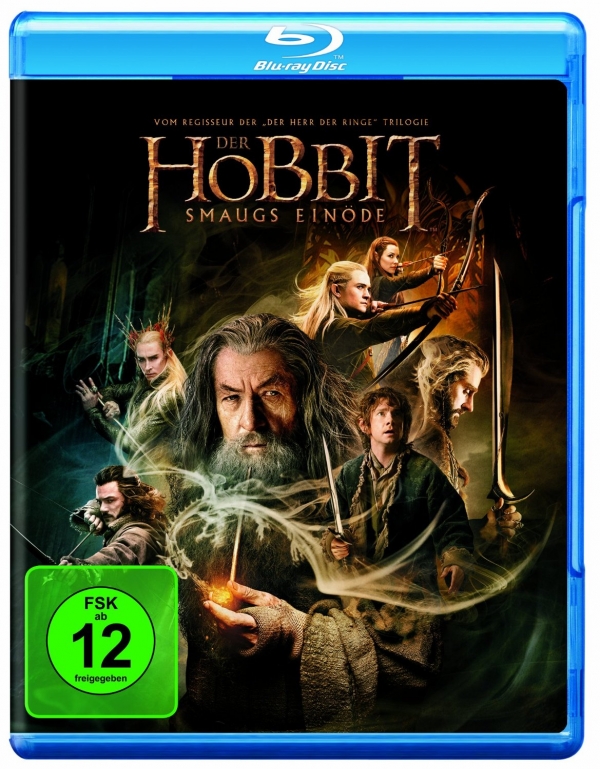
Since April 11, 2014, the second part of The Hobbit, "The Desolation of Smaug," has been available for purchase. In all common formats, including 3D.
In this part, Gandalf the Grey, the thirteen dwarves, and our friend the hobbit Bilbo Baggins set off to the cave where the dragon Smaug is hiding. Smaug must be defeated, and the dwarven kingdom reclaimed.
The 160 minutes are once again filled with adventures. Notable examples include the battles against the spiders in Mirkwood and the heroes' chase while they are in wine barrels against elves and orcs. Of course, there are also many scenes to chuckle at, just like in the previous films from Middle-earth. The scenes with Smaug are also very entertaining, though they do drag on a bit. It is again an entertaining installment, but its negative point is the title, as there is not much of the desolation to be seen. Additionally, the digital editing is quite evident. This makes the film not significantly different from other special effect spectacles. However, that was what gave the "The Lord of the Rings" parts their charm. Almost everything came across as handmade and lovingly arranged, even if it was digitized. In "The Desolation of Smaug," this last love for detail is missing.
Thus, the film is not a blockbuster, but still very entertaining, and those who have grown fond of the world of Bilbo, the elves, the orcs, and many other characters will be well served here. One overlooks the missing connections or new side plots that do not appear in the book.
As extras, the Blu-ray I have contains a lot of interesting discoveries.
Video blogs, behind-the-scenes looks, a music video, and various trailers (including for the video game and the Lego edition "The Hobbit") provide insight into the media machine of "The Hobbit" and how they manage to feed several hundred people in half an hour, among many other things. Especially the behind-the-scenes looks are impressive, showing how large the sets were, how elaborate the filming was, and that the actors, whether dwarf or orc, were very passionate and dedicated to their work.
For fans of "The Lord of the Rings" and "The Hobbit," it is clear that having this part at home is a must. The bonus material definitely makes the purchase worthwhile. Actually, even without it, but there are indeed a few points of criticism, particularly regarding the noticeable digitalization. Less would have been more. Modern technology is not inherently better.


