Q: How was your gig in Dresden yesterday?
A: Super, it was a cool place. The atmosphere was great.
Q: You also played there with PLANLOS. They are on farewell tour.
C: Yes, they made an announcement there that it was the last gig in that club for the band. We only played with them there because they had booked a gig, but we were also booked on the same day. The Chemiefabrik then simply combined everything into one gig. It was our first time in that place. It was really great there. A fantastic punk rock venue.
Q: You have been part of the NIKOLAUS RAUS tour a few times. What does the tour mean to you?
A: Mosti, the singer of A.C.K., always organizes the tour. We have a very friendly relationship with him. In recent years, the bands on the tour have almost always been the same. That’s great for the bands, of course. We know each other well and get along. It’s always a lot of fun to be on tour together.
Q: What does it mean to you to play in squatted houses and alternative clubs?
P: In places like the one we played yesterday, we just belong there. The Tommy-Haus definitely belongs there too.
C: We just feel comfortable in such places.
Q: You celebrated your 20th band anniversary this year. What’s the conclusion after 20 years of Popperklopper?
A: Somehow we probably didn’t manage to jump ship (laughs).
Q: Do you regret that?
C: Definitely not. In recent years we played less, but this year we were out more again. It will continue like that. We’re still excited about it.
A: You can feel it physically. In the past, we played for 10 days in a row. I don’t think that’s possible anymore today. That’s certainly also due to age, but also to personal circumstances, like job and family.
C: In the past, we traveled a lot and played for next to nothing. It was often chaotic. In some places, no one present knew what the schedule was. We just don’t play in such places anymore. It can’t be that you play a gig and then have to take care of all the organizational stuff yourself. There are a few things that just have to run smoothly.
Q: Does professionalism and punk rock go together?
C: Yes, definitely. But that shouldn’t sound too professional. We are anything but professional musicians.
Q: Your band name sounds very much like Deutschpunk. If you were to start a band now, would you name yourselves the same?
C: No! For a very simple reason, the band name has a strong reference to the 80s, when the term Popper was known.
Q: The disco rolls, as they say today. Is there no longer a conflict between punks and those people?
C: Of course, but the term Popper is not as common anymore. We are often approached by young fans who want to know what our band name actually means. If you didn’t grow up in the 80s, then you don’t know the term.
A: Popperklopper is really ultra Deutschpunk!
Q: You started as a Deutschpunk band and then sang more and more songs in English and also leaned more towards the style of English punk rock. Why?
C: We’ve always had English songs, even at the very beginning. The fact that we now have more English songs than before is not intentional. We keep hearing that people think we should sing more songs in German. There have been some Deutschpunk bands that have also sung songs in English from time to time, like Slime. But there are also people who come to us and say they prefer the songs in English.
Q: What are your musical roots?
C: Slime definitely belongs there, but also the old English stuff.
Q: In the past, the punk scene was more about free expression and self-determined life, nowadays it seems to me more about a dignified survival. How do you see that?
P: I agree with you. Back when the punk wave came up, it was definitely about being against something, being different. Nowadays, punk is almost accepted in society. In the past, punk was more of a provocation per se. Today, you have to convey more than just being against something.
A: Punk has now split into so many areas that it’s difficult to talk about a scene, even in a political sense. What is too radical for one is not radical enough for another. There are many small groups, and everyone thinks they do it best. We notice this as a band in what people say about our music. Some would like to hear even more radical lyrics, while others say it’s just about right.
C: In my opinion, it’s important to have your political stance and to maintain it as you age, to just stay involved in some form.
A: Punk is a way of life, and that should also be preserved in your job.
Q: If it had been possible for you back then to live off music, would you have chosen that path?
C: Well, if that had been possible back then, we might have chosen it. But that’s a very tricky issue. If it goes well, it might only go well for three years, and then you’re left empty-handed.
Q: Can the left utilize the terror threat that is currently being stirred up, or does it rather restrict political and social protest?
C: That’s hard to say. On the one hand, it’s said that calm should be maintained, but our interior minister says that there is a concrete major threat. So what is it now?
P: I believe that the terror threat is very much used as a means to push and justify the surveillance of citizens and massive data storage.
Q: You describe this situation in your song “Keine Geheimnisse”. How is it for you to have written a song years ago whose content is now absolutely coming true?
C: That’s kind of strange.
A: The fear has almost become normality by now.
C: It all happens so gradually, and suddenly you’re completely monitored.
Q: From 1996 to 2004, you had a lot of releases, then not much came out anymore. What was the reason?
A: It was due to various reasons. It was actually also due to the time. We had hardly any time to rehearse together for several years, and consequently little time to write new songs.
C: We all lived far apart.
A: By now, at least the drummer and guitarist live in the same place again. This allows us to rehearse more again.
C: You’re right, in recent years there has been little to hear and see from Popperklopper. Right now, things are picking up again, and I hope it will stay that way.
P: You can’t make many new songs with just bass and drums. You need the guitar, and that’s back now.
Q: Was it ever discussed among you, due to the different places of residence, to take someone else into the band who lives closer or in the same place?
P: There was a phase where it was really difficult. We hardly rehearsed and maybe played ten concerts a year. But it was never the case that we wanted to take someone else into the band.
C: I think it’s quite normal to sometimes feel more or less like playing. Now we have a new label, with “Aggressive Punk Produktionen”. They make a good impression. We’re also excited to play again, so the signs for the near future are good.
Q: How do you see the German punk Nachwuchs?
A: From the fans, a lot is split into groups. Overall, the scene is certainly large, but you can tell that some only go to Deutschpunk, others only to hardcore concerts, or only to Oi concerts. The genres have become somewhat smaller, so for example, fewer people go to Deutschpunk concerts than a few years ago. I can hardly think of any bands that have left a lasting impression on me.
H: HAUSVABOT comes to mind.
Q: They also celebrated their ten-year anniversary this year.
P: In recent years, ALARMSIGNAL has really taken off, but they’ve been around for a few years too.
C: ALARMSIGNAL is a classic Deutschpunk band!
P: Very few good up-and-coming bands are breaking through, and the bands that have become a bit more well-known have taken 5-10 years to do so.
A: We ourselves are also mostly on the road with the same bands. You know each other. And when we’re out alone, you meet Rasta Knast or Molotow Soda, who have also been around forever.
Q: The old guard travels together...
C: ...which is usually quite funny.
Q: Speaking of the old guard. You are playing together next weekend with Dritte Wahl, who have also been around for 22 years now. Do you have a connection with them?
C: We get along well. They are nice guys. We used to listen to a lot of Dritte Wahl ourselves. We’re looking forward to the joint concert.
Q: What does the future look like for Popperklopper?
C: We now have a new label. A live DVD of our anniversary concert will be released next year. There will also be many old tracks from us as a bonus. A best-of album is also planned to be released on the new label. We are also actively writing new songs. A new album will also come in the future.
Q: Why are you releasing a best-of album?
A: That was the idea of our new label. We have already released a few records and have been around for some time, so it makes sense to do that.
C: The next record will definitely not take as long to come out as the last one.
Q: Are your first records sold out? Then a best-of album would make sense for the younger generation.
P: We had the first two albums repressed, with a different cover. But there shouldn’t be too many left. “Learning to Die” is definitely completely sold out. The double 7” release “Nadel verpflichtet” has been sold out for a long time, just like the other vinyl singles.
A tour is also planned for 2011 with the bands from our new label. However, I can’t say yet who will be exactly involved.
C: In 2011, several solo concerts are planned for us, as well as some festivals. Maybe we will also play in Poland in 2011. We are working on it, but it’s not easy. If it works out, that would be great. It would be an adventure for us!
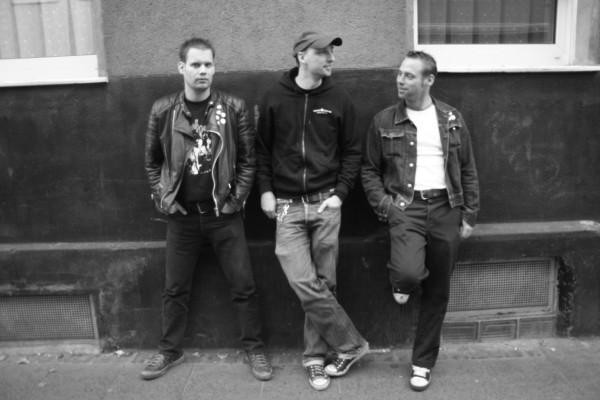
The rest of the evening went very well after a delayed start. Even though POPPERKLOPPER took the stage as the last band well after midnight, they delivered a damn powerful and fast punk set. They showed with their performance that they still have it and are still hungry. POPPERKLOPPER is one of the few good Deutschpunk bands that deliver critical, intelligent lyrics with pressure and speed. As a Deutschpunk fan, you can’t overlook this trio.