
I recently attended a reading or presentation of a scientific paper on fanzines in the GDR. The speaker, who had delved deeply into the subject, informed the audience that punks in the GDR apparently had a greater need for communication than, for example, metalheads or goths. At least when it came to fanzines, punks were ahead.
Now, in every subculture, there are certain behavioral patterns, if not codes, that are desired by the subculture itself, even if they are contradictory. This is, of course, the contradiction inherent in punk, yet they exist.
Punk was once against everything, right?
No Future…Young and broken saves on nursing homes…Anti-Everything faction.
I don’t want to become like my old man…
With such a prominent subculture, which supposedly only existed in its true form in 1977, there is now tons of printed and copied material.
Much important has been said, and even more unimportant.
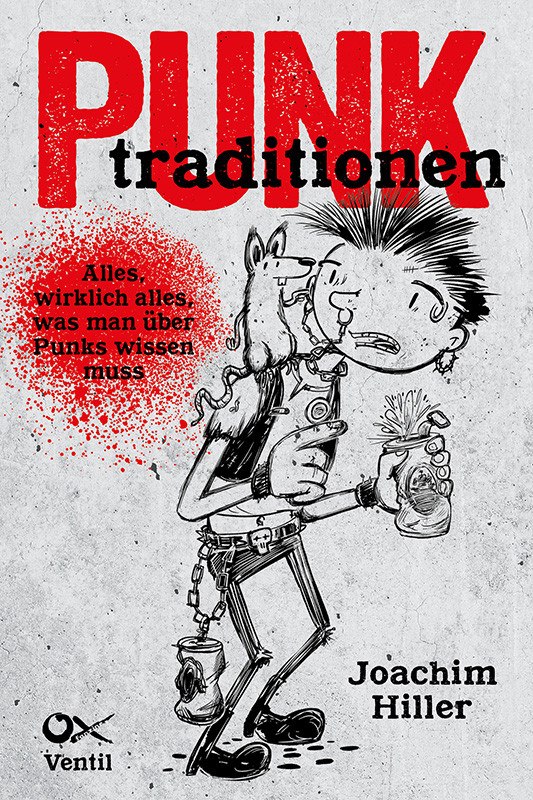
How does it fit that Joachim Hiller, the publisher of Ox (are your reviews still written in font size 5 or have you adapted to the age of your readers and increased the font size?) writes about PUNK TRADITIONS?
In the foreword, he already addresses this contradiction he is aware of and explains that the book should not come across as “Dad telling stories from back then.”
So how can the behavior of a subculture that sees itself as free and individual be pressed into boxes that provide an overview for the uninitiated and do not make punk look like a mere cardboard cutout?
Answer: It can’t…well, not really.
The book is divided into many small chapters that encourage quick flipping through and reading. The chapters cover topics we all know, such as:
Pogo, rats, mohawks, drugs, late concerts, punk leather jackets, or leopard print.
It all reads very entertainingly; here and there I grin and even laugh. It’s written in a light-hearted manner and evokes memories. That’s the truly nice thing about the book.
However, Joachim Hiller does indeed talk about the past, about his own experiences, about what he has heard, and certainly also about one or another anecdote, not to say myth.
So who is this book for, priced at €20.00, which is not exactly cheap?
Is it for kiddie punks who want to find their way in the scene?
Is it for people over 50 who would like to remember their first mohawk?
It’s not entirely clear, but the book is entertaining nonetheless.
Anyone who says that not only punks have certain typical behaviors but also other scenes is absolutely right. Perhaps there will soon be a book on “Gothic Traditions” or “Schlager Move Traditions”? Who knows…